

Texas A&M Research Investment Impact
Federal funding and indirect cost-sharing have enabled Texas A&M University to support the United States in meeting the world's greatest challenges with the nation's best minds. With nearly 150 years of academic and research excellence, Texas A&M values the partnership with federal agencies to make ground-breaking research discoveries that fuel our nation's dominance across a range of critical fields.
Economic Growth Through Federal PartnershipsThe Future of Discovery...
Starting with the first federally funded grants to save the American cattle industry from disease in the 19th century and continuing with our efforts to help put a human on Mars in the 21st century, Texas A&M has greatly contributed to making the United States one of the strongest nations in the world in innovation. With a triple designation as a land-, sea- and space-grant institution, our exploration of the universe is limitless as we study the depths of the ocean, the breadth of our lands, the diseases of our people and animals, and the worlds beyond.


...is Possible with Federal Support
With consistent federal funding, Texas A&M is equipped to help the United States meet the challenges that have overwhelmed all other nations. The United States will lead progress toward solutions to problems in agriculture, energy, defense, artificial intelligence, health, space and so much more — supporting our economy and saving lives. The stories we share here demonstrate the promise of our partnership with the federal government — our enduring commitment to use federal dollars responsibly with maximum impact for Texas, the nation and beyond.
Highlighting Four of Our Areas of Impact
- National Security
- Food, Energy and Water Security
- Improving Health
- Space Exploration
National Security
Texas A&M's leadership in artificial intelligence, biosecurity, cybersecurity, advanced computing infrastructure and military science positions it as the ideal institution to advance national defense solutions. By leveraging our subject matter experts, secure networking, state-of-the-art facilities and interdisciplinary research clusters, our research ensures a safer America for generations to come.

Breakthrough Smart Plastic: Self-Healing, Shape-Shifting, and Stronger Than SteelFunder: Department of Defense
Aerospace engineering and materials science researchers at Texas A&M University have uncovered new properties of an ultra-durable, recyclable, smart plastic — paving the way for transformative applications in the defense, aerospace and automotive industries.
Read Story About Self-Healing Plastics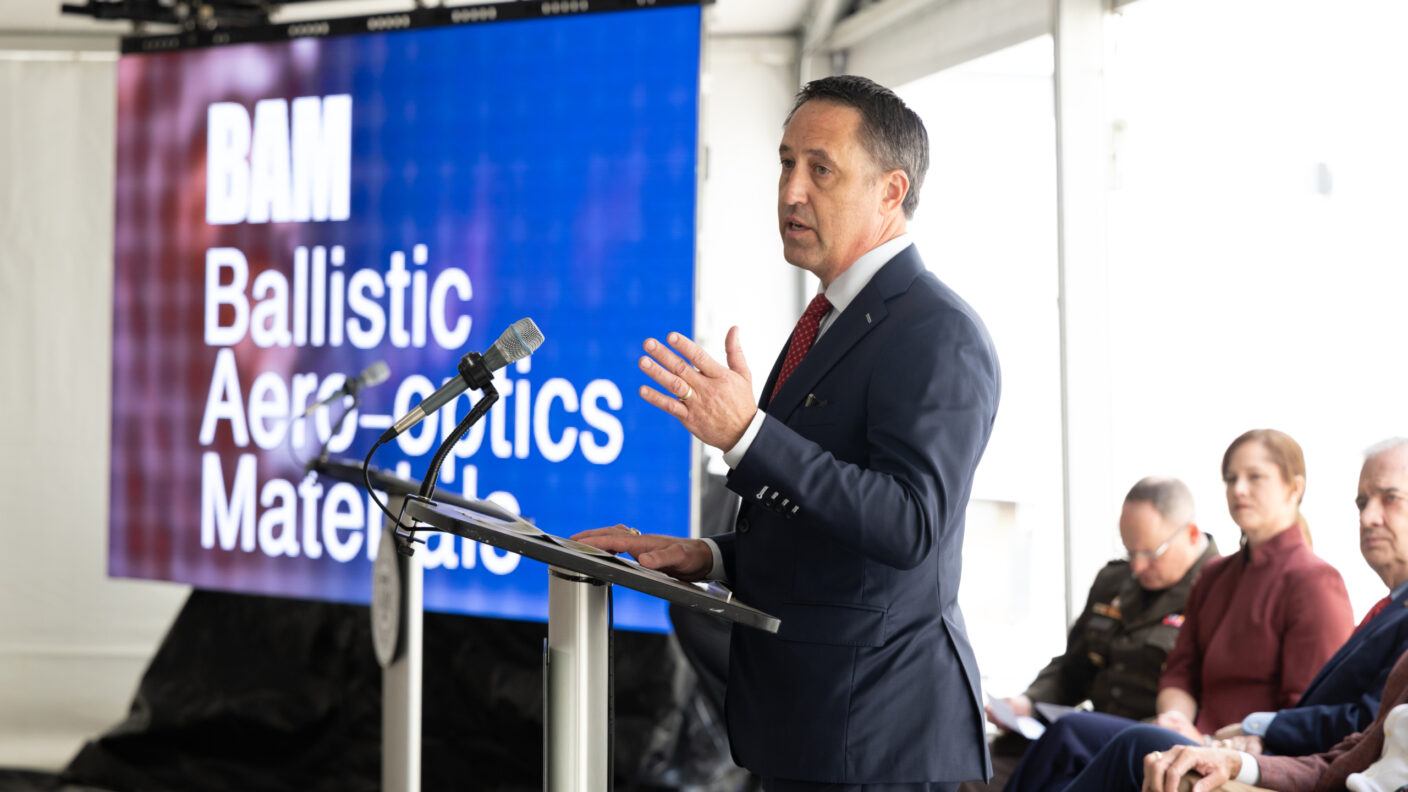
Ballistic Aero-Optics and Materials Range Will Help ‘Bring Fear To Our Enemies’Funders: U.S. Army, NASA
The BAM Range, a giant high-tech tool in the race for the world’s best weapons systems, is open for business on the Texas A&M-RELLIS Campus.
Read Story About BAM Range
Researchers unveil new tool to detect stealth cyberattacks on critical infrastructureFunder: Office of Naval Research
Stealth cyber-attacks against power grids, water systems and other critical infrastructure often go undetected until it is too late. Led by Dr. Irfan Khan, researchers have developed a novel cybersecurity system to detect and defend against these attacks.
Read Story About stealth cyberattacks on critical infrastructure
Texas A&M researcher is revolutionizing medicine with 3D printingFunder: National Institutes of Health
Imagine a childhood in which all of your medications taste good, while simultaneously coming in the exact serving size you need — no wait times for the pharmacy to reformulate them, no adult-sized pills that must be tediously cut in half and no “grape” flavors that taste absolutely nothing like grape. Thanks to the groundbreaking work of Texas A&M University’s Dr. Mansoor Khan, this once-futuristic idea is becoming a life-saving reality. Dr. Mansoor Khan is using 3D printing to create precise, personalized medication doses, a major leap for pediatric care.
Read Story About revolutionizing medicine with 3D printing
Healing the Heart after a Heart AttackFunder: National Institutes of Health & American Heart Association
A new patch developed by Texas A&M University researcher Dr. Ke Huang may offer a way to help the heart heal after a heart attack. The patch uses a unique microneedle system to deliver a therapeutic molecule directly to damaged heart tissue, promoting repair and improving heart function without affecting the rest of the body.
Read Story About the patch
Texas A&M Researchers Go Nuclear On CancerFunder: U.S. Department of Energy Isotope Program
Astatine-211 (At-211), one of a handful of promising alpha-emitting radioisotopes for cancer therapy, is produced in-house within the Texas A&M Cyclotron Institute via the institute’s K150 cyclotron with the support of the U.S. Department of Energy Isotope Program. At-211 has been described as the “perfect” or “goldilocks” isotope because of its potential ability to efficiently deliver radiation to kill cancer cells without leaving harmful secondary decay products in the body. The revolutionary radioisotope has demonstrated significant potential in the treatment of blood, ovarian and specific types of brain cancers.
Read Story About Texas A&M Cancer ResearchFood, Energy and Water Security
Texas A&M is dedicated to meeting the challenges raised by global shifts in the risks associated with food, energy and water securities. These areas are interconnected and Texas A&M takes a holistic, trans-disciplinary and multi-stakeholder approach to explore and safeguard the vital functions each has in achieving prosperity for the United States.

Texas A&M researchers develop metallic gel that could transform batteriesFunder: Department of Energy
Researchers at Texas A&M University have developed the first known metallic gel. Unlike everyday gels, like those used in hand sanitizers, hair products or soft contact lenses, this new material is made entirely of metals and can withstand extreme heat. The discovery could be a game changer for energy storage.
Read Story about metallic gel
Ice-Cooled Buildings Could Ease Strain On Power GridFunder: U.S. Department of Energy
Texas A&M researchers are working to improve an “ice battery” system that freezes water at night to cool buildings during the day. Ice battery systems work by freezing water or other materials at night, when electricity is cheaper and demand is lower. The stored cold is then used to cool buildings during the day, reducing peak energy use and lowering costs. While the concept isn’t new, Shamberger’s research addresses a key challenge: how to make the materials inside these systems more efficient, stable and long-lasting.
Read Story about ice batteries
AI Turns Drone Footage Into Disaster Response Maps In MinutesFunder: National Science Foundation
A tool developed at Texas A&M University is set to transform how emergency responders assess damage after disasters. The technology, known as CLARKE (Computer vision and Learning for Analysis of Roads and Key Edifices) uses artificial intelligence and drone imagery to evaluate damage to buildings, roads and other infrastructure in a matter of minutes.
Read Story about Disaster Response Maps
Researchers uncover potential biosignatures on MarsFunder: NASA
A new study co-authored by Texas A&M University geologist Dr. Michael Tice has revealed potential chemical signatures of ancient Martian microbial life in rocks examined by NASA’s Perseverance rover. The findings, published by a large international team of scientists, focus on a region of Jezero Crater known as the Bright Angel formation — a name chosen from locations in Grand Canyon National Park because of the light-colored Martian rocks.
Read Story about potential biosignatures on Mars
From sea to space, this robot is on a rollFunder: NASA
While working at NASA in 2003, Dr. Robert Ambrose, director of the Robotics and Automation Design Lab (RAD Lab), designed a robot with no fixed top or bottom. A perfect sphere, the RoboBall could not flip over, and its shape promised access to places wheeled or legged machines could not reach — from the deepest lunar crater to the uneven sands of a beach. Two of his students built the first prototype, but then Ambrose shelved the idea to focus on drivable rovers for astronauts. Now, two decades after the original idea, RoboBall is rolling across Texas A&M University.
Read Story about the RADLab
Spacecraft That Sweat? A Cool New Way to Tackle Atmospheric ReentryFunder: NASA
As space travel becomes more common, the need for fully reusable spacecraft is growing. One potential solution? A spacecraft that sweats. The Department of Aerospace Engineering at Texas A&M University is partnering with Canopy Aerospace to develop and test a 3D-printed material that releases or “sweats” a coolant gas to protect spacecraft. This technology, part of a $1.7 million Air Force Small Business Technology Transfer grant, could enable the design of fully and rapidly reusable spacecraft.
Read Story about Atmospheric Reentry